From War to Dialogue: U.S. Delegation Meets Taliban Officials in Doha – July 2023
The U.S. State Department announced on Wednesday, July 26, 2023, that U.S. officials would meet with Taliban representatives and “technocratic experts” from key ministries of the group in Doha.
 (Amir Khan Muttaqi (center) and Tom West (right) during their meeting in Doha, Qatar.)
According to the U.S. State Department, Tom West, the U.S. Special Representative for Afghanistan, and Rina Amiri, the U.S. Special Representative for Afghanistan’s Women and Human Rights, were scheduled to visit Astana, Kazakhstan, and Doha, Qatar, from July 26 to 31 and meet with a Taliban delegation.
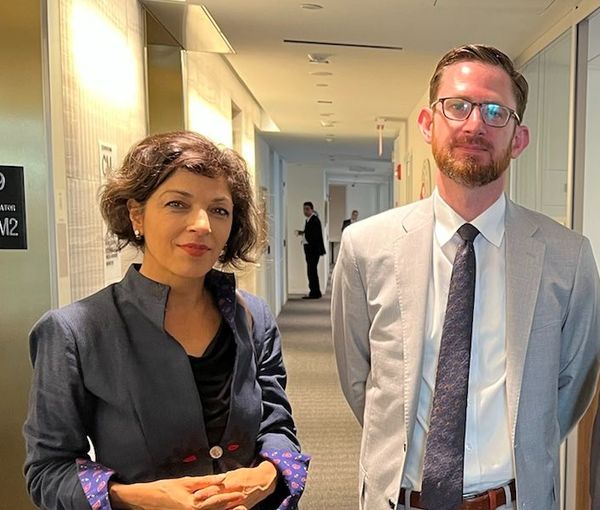 (Rina Amiri and Tom West during their trip to Doha, Qatar.)
The State Department said that U.S. officials would discuss security, counter-narcotics issues, and women’s rights with Taliban officials. Amir Khan Muttaqi, the Taliban’s acting foreign minister, traveled to Doha at the head of a delegation on Saturday, July 29, 2023. Before his trip, Muttaqi said that he would discuss the “cancellation of sanctions, blacklist, release of Afghan assets and violation of airspace” with American officials.
Table of Contents
1. The U.S.–Taliban Meeting in Doha
2. U.S.–Taliban Relationship: From War to Dialogue
3. Paying Ransom to the Taliban
4. Conclusion
1. The U.S.–Taliban Meeting in Doha
Since the Taliban regained control of Afghanistan, the meeting marked one of the first occasions on which a large U.S. delegation held direct talks with senior officials of the group. The 15-member American delegation was led by Tom West, while the Taliban delegation was led by Amir Khan Muttaqi, the group’s acting foreign minister.
 (Amir Khan Muttaqi and Tom West during their meeting in Doha, Qatar.)
The meeting, which lasted two days, was widely criticized and interpreted by opponents of the Taliban as a “betrayal of human values.” According to the Taliban Foreign Ministry, the talks focused on “building trust between the two sides, taking practical steps in this direction, removing blacklists and lifting sanctions, freeing the reserves of Da Afghanistan Bank, maintaining the economic stability of Afghanistan, and fighting against drugs and human rights issues.”
The Taliban Foreign Ministry said that the group had “once again emphasized” the importance of removing blacklists and bounties and releasing Afghan central bank reserves as measures to build confidence. According to the ministry, this would allow Afghans to build their own economy without relying on foreign aid. The ministry also stated that “the two sides continued to emphasize the continuation of such meetings, understanding and interaction.”
2. U.S.–Taliban Relationship: From War to DialogueThe first period of Taliban rule ended after the U.S. intervention in Afghanistan in 2001 and the fall of the Taliban’s Islamic Emirate. During the following twenty years, the Taliban carried out deadly attacks across Afghanistan in its war against the Afghan government and foreign forces, causing extensive civilian suffering. Many of the victims were Afghan civilians, including women and children. According to Afghan political and civil society activists, civilians — particularly members of the Hazara Shia community — were targeted and abducted for allegedly supporting the Afghan government, which the Taliban regarded as a U.S.-backed puppet regime.
In various incidents, the Taliban have also been accused of killing Hazaras, including children, because of their support for the republican system, participation in elections, pursuit of education, attendance at universities, or advocacy for peace. Many Afghan citizens and political leaders have argued that the Taliban used the presence of U.S. and other foreign forces as a pretext for violence against the Afghan population and have accused the group of committing “crimes against humanity” during the twenty-year conflict. Following the “Doha Deal” and the process that ultimately enabled the Taliban to regain control of Afghanistan, critics have increasingly pointed to what they see as a new phase in U.S.–Taliban relations. The two-day meeting in Doha became a prominent example of this shift, although the specific outcomes and agreements concerning the future of Afghanistan remained unclear.
Over the previous two years, as U.S.–Taliban engagement continued, the Taliban also continued to impose restrictions on the Afghan population and to curtail fundamental rights, particularly those of women and girls. The continuation of U.S. engagement with the Taliban therefore raised serious questions about how Washington could maintain diplomatic relations with a group whose policies inside Afghanistan continued to restrict fundamental rights, particularly those of women and girls. Some critics have described the relationship as a “secret deal” between the Taliban and the United States and have referred to the Taliban as “America’s Wagner in the region.” These descriptions reflect the views of critics of U.S. policy and of the Taliban rather than established facts about the nature of the relationship.
3. Paying Ransom to the TalibanAfghan women’s protest movements interpreted the Doha meeting between the Taliban and American representatives as a form of “extortion” and a “betrayal of human values.” The protesting women argued that the Taliban lacked the ability to govern in a way that could meet the needs of the Afghan people or engage constructively with the international community, and they described interaction with the group as a form of blackmail. In their protests, the women called on the international community to support the people of Afghanistan rather than support what they described as a “mono-ethnic,” “mono-gender,” and “terrorist” group. They also called for the groundwork to be laid for the establishment of a democratic government based on the votes of the people.

The protesting women also called on Qatar — which has hosted the Taliban since 2012 and has maintained the group’s political office — not to intervene in Afghanistan’s affairs in the Taliban’s favor or lobby internationally to “whitewash the international image of this group.”
Afghan citizens, particularly women, have called for an end to Taliban rule, citing what they describe as “massive human rights violations,” “war crimes,” and the group’s alleged sheltering of more than twenty terrorist organizations. They have condemned meetings between American officials and the Taliban, describing such engagement as a “bargaining” over the fate of the Afghan people.
4. ConclusionA significant number of Afghan critics of the Taliban have come to view the group as “puppets” advancing what they believe to be America’s long-term goals in the region, while at the same time depriving the Afghan people of security, peace, prosperity, and basic freedoms. The Doha meeting therefore represented more than another diplomatic encounter for many of the Taliban’s Afghan opponents. It became a symbol of the dramatic shift from two decades of armed conflict between the United States and the Taliban toward direct political dialogue between the former adversaries.
SourceThis article was originally published in Dari and can be read here.
The subsequent article on Thomas West’s statements and the continuation of U.S. engagement with the Taliban can be read here.


Comments
Post a Comment